

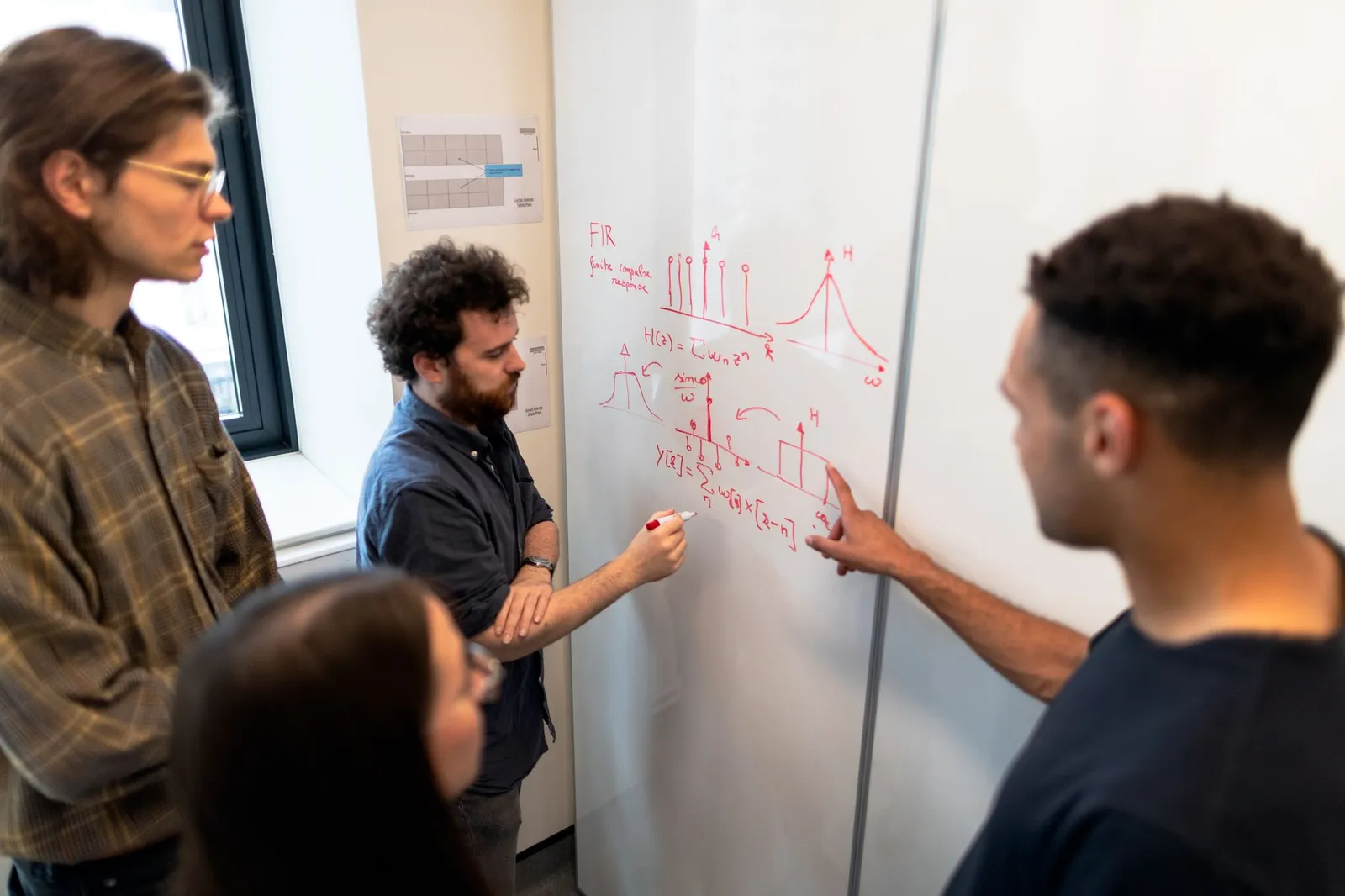
An AI research scientist develops new methods for getting computers to learn, reason or perceive, tests them in experiments and publishes the results. It is a research job, not a product-building one. BLS lists a master’s degree as the typical entry education, and the national median pay is $140,300 a year. Openings are fewer than for software roles, so the details below matter.
What Does an AI Research Scientist Do?
The job title says AI, but BLS doesn’t have a line for it. AI research scientists fall under computer and information research scientists, a group that covers researchers across computing, not only machine learning. That broader group is the source of every figure on this page, so read the pay numbers as a close match for the job, not a count of AI specialists alone.
BLS lists the duties for the group. They map neatly onto AI work.
- Explore problems in computing and develop theories and models to address them.
- Collaborate with scientists and engineers to solve complex computing problems.
- Determine computing needs and system requirements.
- Develop new computing languages, software systems and other tools.
- Design and conduct experiments to test the operation of software systems.
- Analyze the results of those experiments.
- Write papers for publication and present findings at conferences.
Notice what is missing. Nothing on the list says “ship a feature” or “support customers.” The output of the job is knowledge, usually a paper, a prototype or a method that someone else turns into a product.
What Does a Day Look Like?
BLS doesn’t publish a daily schedule, so what follows is how the duties above usually play out in AI. Treat it as an illustration, not a fixed routine.
A typical stretch starts with reading. You catch up on what other labs have published, because your idea may already exist or may have been shown not to work. Then you write code to try your own approach on a dataset, which means running a training job and waiting for it.
While the job runs, you plan the next experiment, sketch the math on a whiteboard with colleagues or write up a section of a paper. When the results come back, you check whether the improvement is real or noise. That analysis step is the one BLS lists by name, and it is where a lot of the skill lies.
Many experiments fail. A research scientist spends a large share of the week with results that don’t confirm the idea, and learning to read a failed experiment is part of the work. If you need steady, visible output every week, applied engineering may suit you better.
Which Degree Do Employers Expect?
BLS lists a master’s degree as the typical entry-level education for this occupation. That is the single most useful fact on the page. Many AI engineers are counted with software developers, where BLS lists a bachelor’s, so this job asks for a step more school than that route.
Typical is not the same as required. Employers write their own postings, and a posting can ask for a different level. We can’t tell you what any one employer will accept, so treat BLS as the center of the range and read the education line in each posting you care about.
Here is how the levels line up with the work.
| Degree Level | Where It Fits | What to Check |
|---|---|---|
| Bachelor’s | A base in math and programming, and the way into a master’s | Strong calculus, linear algebra and probability coursework |
| Master’s | The typical entry level BLS lists | A thesis or research option, and a path to a faculty advisor |
| Doctorate | Deeper research training | Dissertation requirements, time to finish and how advising works online |
If you already hold a bachelor’s in computer science, engineering or math, the master’s is your next step. If you don’t, our guide to AI degree requirements explains the prerequisites many programs list.
Why the Thesis Option Matters
A research job asks you to do research. A degree that includes a thesis or dissertation is the closest thing a program can give you to the real work. You pose a question, design the experiments, defend the result and write it up.
A coursework-only master’s can still be a fine choice for engineering roles. For this specific job, check whether the program lets you do original research. Our ranking of online AI master’s programs with a thesis option filters for that.
Several programs in that ranking are worth knowing. The Capitol Technology University MRes in Artificial Intelligence requires a master’s dissertation that you present and defend, at $19,950 for 30 credits. Capitol’s MPhil in Artificial Intelligence requires a written thesis and oral defense and totals $23,940 for 36 credits.
The online M.S. in Artificial Intelligence at NJIT lets you choose a master’s thesis instead of a master’s project, and totals $38,520 for 30 credits. The University of Bridgeport’s M.S. offers a thesis option with 8 courses, or a project option with 9, at $33,000.
Programs change their rules, so confirm each one on the school’s own page. Be careful about one thing in particular: a thesis needs an advisor, and an online program has to tell you how you’ll meet one.
What About a PhD?
Our data includes two fully online doctorates, both at Capitol Technology University: a PhD in Artificial Intelligence and a PhD in Machine Learning. Each is 60 credits at $980 a credit, for $58,800 total. The AI program is typically three years, with two as a minimum, and it ends with a dissertation and an oral defense.
BLS doesn’t say a doctorate is required. Whether you need one depends on the employer and the kind of research. Ask people who hold the job you want what they have, and read postings at the places you’d like to work.
One honest caution. A research doctorate takes years of independent work, and the online format doesn’t change that. If you aren’t sure you want to do research for years, a thesis master’s is a cheaper way to find out.
How Do the Degree Programs Compare?
We keep three rankings that match this job. Start with the one that fits where you are now.
- Online master’s in artificial intelligence compares the typical-entry degree by price, format and GRE rules.
- Online AI master’s with a thesis option narrows to programs where you can do original research.
- Online machine learning degrees covers programs built around the methods most AI research uses.
If cost is the constraint, the cheapest online AI degrees list sorts by price. The lowest-priced master’s on our list is the University of Texas at Austin’s online MS in Artificial Intelligence at $9,990 for 30 credits, with no GRE required. It doesn’t offer a thesis, so a research-minded student might pair it with a project outside class.
We don’t tell you which program is best for you, because it depends on your background. Read each program’s page for the admissions rules and costs.
Which Skills and Tools Does the Work Use?
BLS doesn’t publish a skills list for the occupation, so this section describes what the duties require rather than what any one employer demands. Use it as a study plan.
Math. Linear algebra, calculus, probability and statistics are the language of machine learning papers. You will read them constantly, so a program that lists these as prerequisites is telling you something real. NJIT’s admissions page, for example, asks for prior coursework in calculus, programming, data structures and algorithms, probability and statistics, and linear algebra.
Programming. You write code to test ideas. Python is the common language in machine learning research, and frameworks such as PyTorch are widely used. You don’t need to be a polished software engineer, but your experiments must be correct and repeatable.
Experiment design. BLS names designing and conducting experiments and analyzing results. In practice that means controlling variables, using proper baselines and not fooling yourself with a lucky run.
Writing. The job ends in papers and conference talks. Clear writing is a skill you can practice with a thesis.
Reading. Much of the work is keeping up with the literature. Get comfortable reading a dense paper in an hour or two.
How Do You Get Hired, Step by Step?
There’s no single path, so here is a sequence that matches what BLS and our program data support.
- Read ten postings first. Search the job title and related titles, and note the education lines and the methods they name. This tells you what a real employer asks for, and no page can.
- Build the math and programming base. If your background is thin, finish prerequisite coursework before you apply to a master’s. Many programs list these in their admissions rules.
- Choose a master’s with research in it. Pick a program with a thesis or research option, and confirm how advisors work online. Use the three rankings above to compare.
- Do a real project. Reproduce a published result, then change one thing and test it. Document what you tried, including what failed.
- Write it up. The job produces papers, so a clear write-up of your thesis or project is the strongest sample you can show.
- Decide whether to go further. If postings you want ask for a doctorate, price a PhD against what it gets you. If they don’t, apply with your master’s.
- Apply and talk to people. Contact researchers whose work you’ve read and ask what they look for. Their answer beats any general advice.
What Do AI Research Scientist Jobs Pay?
All pay figures here come from the BLS Occupational Employment and Wage Statistics survey for May 2025, for computer and information research scientists. The survey counts 37,200 people in the occupation.
- The median is $140,300 a year, or $67.45 an hour.
- The mean is $153,930.
- The lowest tenth earn $82,200 or less.
- A quarter earn $103,570 or less, and a quarter earn $188,700 or more.
- The highest tenth earn $230,630 or more.
The spread is wide, and it mixes people at every experience level and in every state. Don’t read the lowest figure as a starting salary or the highest as a ceiling for a new graduate.
Our AI research scientist salary page goes deeper on percentiles, states and the cost of a degree next to this pay.
Where Are the Jobs and the Highest Pay?
Location matters more here than in most careers. By median wage, Oregon is at $206,220, Washington at $202,400, New York at $181,990 and Massachusetts at $170,510.
By number of jobs, California is far ahead with 8,440, then Virginia with 3,590, Maryland with 2,870, Washington with 2,050 and Texas with 1,960. California’s median is $159,100.
At the low end, Michigan’s median is $82,590 and Indiana’s is $85,460. Be careful with small states. Oregon has 730 workers in this occupation, so a few people can move its numbers.
Most of the jobs sit in a handful of metros, and that shapes your search. If you need to stay put, check which employers in your region hire researchers before you commit to a degree.
What Is the Outlook?
BLS projects employment of computer and information research scientists to grow 22 percent from 2025 to 2035, which it describes as much faster than the average for all occupations. That means about 8,400 added jobs on a base of 38,600 in 2025.
BLS also projects about 2,900 openings a year, a figure that includes people leaving or changing jobs as well as new positions.
The base is small. Compare 38,600 jobs with the far larger software developer group, and you can see why research postings are scarcer. Fast growth on a small base still means a limited number of seats, so plan to be a strong candidate, not just a qualified one.
Projections are estimates, and BLS revises them each cycle.
Can You Work Remotely or Study Online?
There are two questions here, and the answers differ.
Studying online. Yes. Programs on our list deliver the master’s and the PhD fully online, including programs with a thesis. The part to examine is research access. You need an advisor, and a program should say how you’ll reach one.
Working remotely. We can’t give you a figure, and we won’t guess. BLS reports pay and jobs by state, and they cluster. Each posting states its own location rules, so read for on-site requirements before you apply. If remote work matters to you, make it a filter in your search, not an assumption.
Our guide on whether an AI degree is worth it can help you weigh the cost against pay for your own situation.
What Should You Do Next?
Start with the postings. Ten real job descriptions will tell you more about what employers want than any guide, including this one.
Then pick a rung. If you’re deciding on a master’s, compare the online master’s programs and then narrow to those with a thesis option.
If you aren’t sure research is for you, read about the other jobs in our map of artificial intelligence careers. Building products pays well too, and it asks for a different degree.
Computer and Information Research Scientists Pay by State
In May 2025, the Bureau of Labor Statistics reported a median annual wage of $140,300 for computer and information research scientists nationwide, with the middle half earning between $103,570 and $188,700. About 37,200 people held these jobs.
Oregon had the highest published state median at $206,220, and Michigan the lowest at $82,590. The table lists every state where BLS publishes a median for this occupation.
| State | Median | 10th Percentile | 90th Percentile | Jobs |
|---|---|---|---|---|
| Oregon | $206,220 | $117,570 | $351,690 | 730 |
| Washington | $202,400 | $95,890 | $281,050 | 2,050 |
| New York | $181,990 | $95,260 | $314,130 | 1,950 |
| Massachusetts | $170,510 | $77,160 | $233,340 | 1,760 |
| New Mexico | $165,690 | $101,210 | $257,950 | 490 |
| California | $159,100 | $88,920 | $275,320 | 8,440 |
| Virginia | $157,390 | $96,300 | $230,630 | 3,590 |
| Maryland | $145,310 | $98,380 | $195,190 | 2,870 |
| District of Columbia | $144,190 | $100,010 | $196,640 | 330 |
| New Jersey | $140,840 | $85,780 | $209,850 | 1,580 |
| Illinois | $136,540 | $49,190 | $243,360 | 630 |
| New Hampshire | $136,160 | $90,760 | $246,160 | 90 |
| Minnesota | $135,850 | $83,920 | $174,740 | 30 |
| Ohio | $135,510 | $44,920 | $173,510 | 280 |
| Hawaii | $134,350 | $90,960 | $165,690 | 70 |
| Nevada | $134,310 | $85,940 | $190,400 | 80 |
| Colorado | $133,160 | $84,660 | $215,090 | 400 |
| Connecticut | $131,650 | $129,690 | $131,650 | |
| Pennsylvania | $130,300 | $83,330 | $175,480 | 330 |
| Arizona | $129,760 | $62,870 | $386,290 | 360 |
| North Carolina | $128,370 | $82,410 | $182,050 | 600 |
| Missouri | $127,820 | $73,630 | $200,010 | 230 |
| South Carolina | $126,980 | $84,200 | $161,180 | 430 |
| Rhode Island | $121,470 | $91,230 | $170,680 | 500 |
| Texas | $121,210 | $65,480 | $204,250 | 1,960 |
| Florida | $119,810 | $73,780 | $194,840 | 1,070 |
| Alabama | $117,870 | $63,290 | $174,030 | 570 |
| Louisiana | $115,210 | $80,250 | $161,120 | 140 |
| Mississippi | $109,050 | $69,220 | $161,890 | 300 |
| Tennessee | $108,830 | $82,750 | $174,760 | |
| Utah | $94,700 | $72,990 | $169,890 | 1,250 |
| Oklahoma | $93,100 | $71,930 | $136,340 | 590 |
| Georgia | $92,250 | $73,780 | $153,630 | 810 |
| Indiana | $85,460 | $65,820 | $134,490 | 720 |
| Michigan | $82,590 | $66,700 | $159,500 | 530 |
Frequently Asked Questions
What Does an AI Research Scientist Do?
Do You Need a PhD to Be an AI Research Scientist?
What Do AI Research Scientist Jobs Pay?
Can You Become an AI Research Scientist With an Online Degree?
Are AI Research Scientist Jobs Remote?
Is AI Research Scientist a Growing Career?
What Is the Difference Between an AI Research Scientist and an AI Engineer?
Sources
- Occupational Outlook Handbook: Computer and Information Research Scientists
- Occupational Employment and Wage Statistics, May 2025
- PhD in Artificial Intelligence
- Master of Research in Artificial Intelligence
- Online M.S. in Artificial Intelligence
All sources retrieved .